
How does Opera make money? An explainer on monetization
Share


Hi, Opera users!
As many of you know, our products are free to download and use – so one of the most common questions we get from users is, “how does Opera make money?” It’s a fair question, and the answer is pretty straightforward:
Opera monetizes through:
- Advertising
- Search partnerships
- Subscription-based products (in some cases)
It might sound mundane on the face of it but it is how Opera is able to offer a wide range of great products for absolutely free. So if you’ve ever wondered about it, you’ve come to the right place. Let’s break it down in more detail.
It’s all public info
First off, as we state on our website, Opera is publicly listed on the NASDAQ stock exchange in New York. This means that every three months, Opera publishes a detailed report of all its activities, according to the regulations of the Securities and Exchange Commission (SEC) of the United States.
In these reports, which are available to everyone, users can find details of how Opera has performed financially in the past quarter, and where our revenue has come from. As a public company, Opera has obligations of transparency and disclosure that many of our competitors don’t. So in Opera’s case, such transparency is informed not just by our commitment to our users, but also by international regulations and standards.
So where does the revenue come from?
With that in mind, let’s look into the different ways that Opera makes money.
Advertising
If you allow it, we show you ads that, depending on your preference, can be personalized to you and your interests, or they can be completely random. This is a big part of what informed consent means – you can choose to share some data with us so that the ads you see are relevant to you. Or you can choose not to, in which case you might see some more generic ads.
Opera ad network
How do these ads work though? Part of our business includes Opera Ads – our own global ad network. This allows Opera to display advertising from our ad partners, who wish to get their product in front of our considerable user base. To do that, we collect a limited amount of data that includes a randomly-generated user ID, your city or country, and broad categories of sites you browse. These categories can be, for example, Travel, Sports, or Shopping.
Based on these categories, your randomly-generated user ID is placed in a user segment – a large collection of anonymized user IDs that share a common feature – such as interest in Sports, for example. These segments are built so that no individual user can be identified through them. And even these broad, anonymized segments never leave our servers – advertisers come to us with their ads, and we match them to the right users. We store this data for up to a year, after which it is automatically deleted, and we never make it available to others.
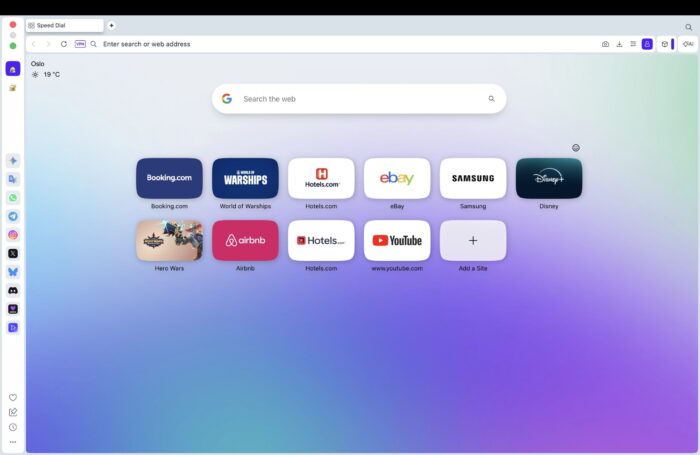
Speed Dials
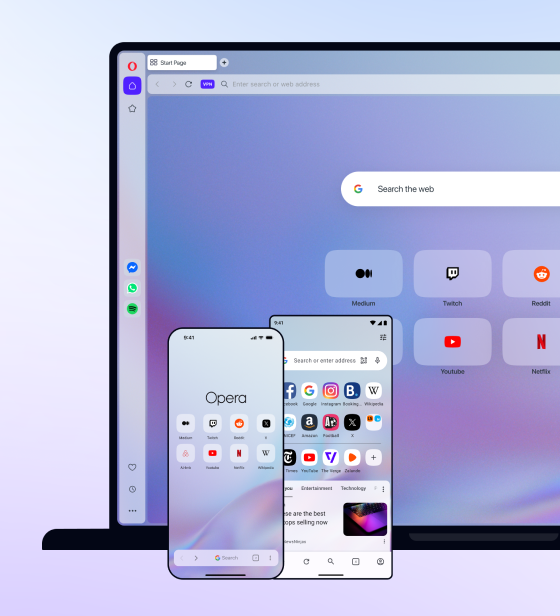
Speed Dials, which we debuted all the way back in 2007, today are a very common way for browsers to monetize. They are, essentially, sponsored bookmarks in the Start page. If you click on a sponsored Speed Dial, say for example a link to Disney+ or Booking, then that site receives a token that tells them that this user came from that specific bookmark, and we earn some money for that.
The data here only serves to show the website that a visitor came through Opera. No other personal data is collected by the Speed Dial itself or the browser. And of course, clicking on a Speed Dial is an entirely voluntary action – if you don’t use it, nothing happens. Speed Dials are also completely customizable – if you don’t wish to see them, you can replace them with your own or you can disable that entire section through the settings for a cleaner, more minimalist look.
Promoted suggestions
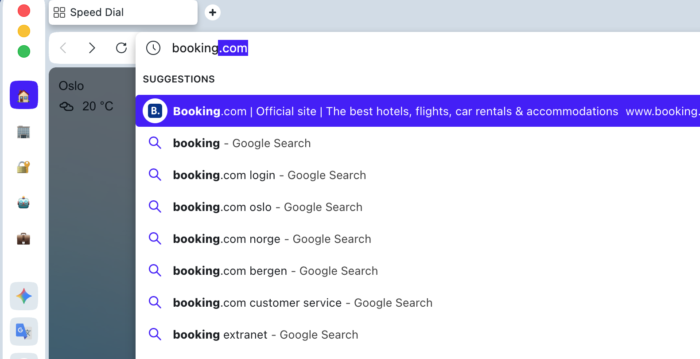
This is a feature that’s similar to Speed Dials. When you start typing in the address bar, you might see an auto-complete suggestion for the site you’re looking for. We partner with some websites so that, when you start typing that particular website’s URL, you will see a suggestion to visit that site. If you press “enter” while the suggestion is selected, we earn some money through an affiliate link placed within the suggestion.
Like Speed Dials, this feature does not rely on your personal data, and is completely voluntary to use – if you decide not to click on our suggestion, and simply complete the URL manually or navigate to the organic suggestions underneath the Promoted one, the affiliate link is not added and we don’t earn any revenue. Promoted suggestions can be toggled off completely through the browser settings so that you never encounter them if you don’t wish to.
Search partnerships
Another common way for independent browsers to monetize is through partnerships with search providers. Opera was one of the first browsers to add a dedicated search bar in its UI – and of course, these days the browser’s address bar is multi-functional, enabling search as well as typing in URLs.
We work with search providers, for example Google, so that if you choose to use their search engine to search with on Opera, we earn some revenue with each search. We don’t collect the contents of your searches, nor do we process this data in any way. The only thing we track is the fact that a search has taken place on this particular search engine through our browser.
As always, users are free to use their preferred search engine with Opera, and switching between different search providers is a breeze. Opera even features keyboard shortcuts for the address bar so you can use your favorite search engine without having to dive into the settings.
Premium services
While advertising and search are our primary sources of revenue, we also offer some paid products and services. These are offered on a subscription basis with monthly or annual plans. They allow us to bring some more highly specialized offerings to our users that we would otherwise be unable to provide for free.
Our main subscription-based products at the moment are:
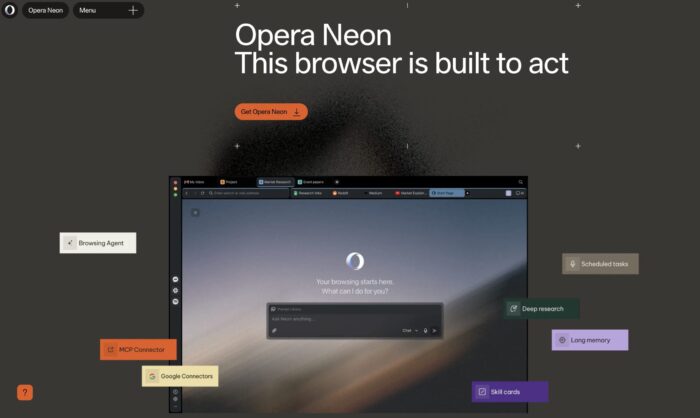
Opera Neon
Our AI agentic browser Opera Neon is available for a monthly subscription of $19.90. The fee gives you full access to our experimental AI powerhouse browser, with some of the most advanced AI models, top agentic AI features, and versatile model connectors. In other words, a browser for true AI power users.
VPN Pro
While Opera was the first browser to boast a completely free in-browser VPN, we also offer a premium, device-wide VPN service called VPN Pro, which allows you to protect up to six Desktop and Android devices at the same time. VPN Pro is a natural next step from the browser-only protection of our free VPN; it’s powered by the state-of-the-art Lightway protocol, and offers faster access to servers in 48 countries. A VPN Pro subscription can start from as little as $4 per month.
Your data, your choice
So there you have it – how Opera manages to keep the lights on, pay employees’ wages, maintain and develop products, and grow to new markets. As you might notice, all our monetization avenues rely on you, our users, making the choice to support us and allowing us to continue offering you great products and services for free.
Making this choice means you place our trust in Opera, and this is something that we don’t take lightly. This is why we will continue to emphasize your right to choose, ensure that your privacy is respected, and that you are always informed so that you know exactly what you are opting into – or out of. Make sure to read our Privacy Statement for more information on our data policies.
And if you choose to use Opera but not support any of our monetization avenues – hey, we’re still happy you’re here!

User comments
You deserve abetter browser
Faster, safer and smarter than default browsers. Fully-featured for privacy, security, and so much more.


You deserve a better browser
Opera's free VPN, Ad blocker, and Flow file sharing. Just a few of the must-have features built into Opera for faster, smoother and distraction-free browsing designed to improve your online experience.